

Three American Devils
A Reading List for Early Views of Satan in the New World
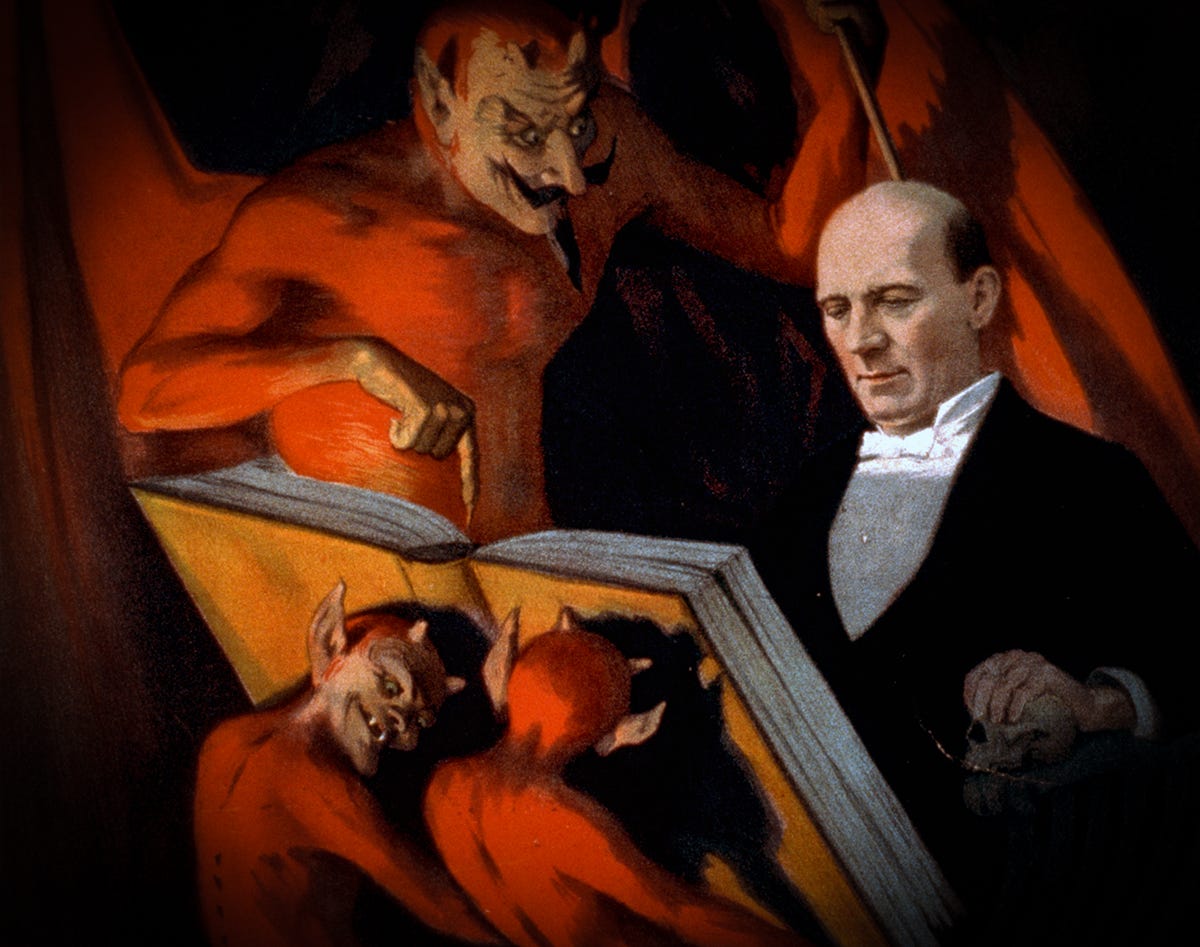
For many people, the devil is always hiding right around the corner, waiting for a chance to deceive, to trick, to bargain, to steal. This is nowhere more apparent than early America. Spend enough time digging through the archives of early American print, and the devil starts to feel like a citizen of the New World.
He slips out of sermons, and into literature, leaps from cheap pamphlets and leers from early woodcuts and etchings. He’s not just a metaphor or an idea. He is a force in a budding republic, political, playful, demonic, sinful, and terrifying. A trickster monster, a true deceiver, no deal with the devil works out in one’s favor. And yet, the stories explore this trope, and this character, over and over.
What follows is a short reading list that traces some early ideas of the devil as he appeared in American print.
1. The Wonders of the Invisible World by Cotton Mather (1693)
This book is Cotton Mather’s attempt to justify the Salem witch trials. It presents New England as a battleground where Satan and his agents work through witches, pacts, and spectral assaults to overthrow God’s “plantation” in the wilderness. Considered by some to be a work of demonology, it is part trial record, part twisted theology, and shows just how real the devil felt to the people who perpetrated the witch trials in Salem. The devil in these pages had the power to shape law, theology, and every day life.
2. A Very Remarkable Account of the Vision of Nathan Culver by Nathan Culver (1791, reprinted 1793)
Nathan Culver presents himself as a sinner who receives a vision in 1791. According to the text, Christ allows him to glimpse heaven and then the torments of Hell, where the devil appears as a great jailer, holding the souls of the damned for eternity. As an account of a supposed vision, this text lets you see the devil’s work firsthand, and tries to turn people away from immoralities of the time by targeting the pamphlet audience.
3. The Wonderful Appearance of an Angel, Devil, and Ghost, to a Gentleman in the Town of Boston by John Boyle (1774)
This one may feel a bit familiar. A man in Boston is visited over three nights by an angel, the Devil, and a ghost, each with something to say about his life, his choices, and his morals. The devil’s appearance in this pamphlet is a political one, and he speaks about the state of the colonies, and the dangers of corruption. The pamphlet reads like a colonial dream vision fused with politicized editorial. It’s a great example of early American print inserting Satan as a voice in political debate, putting him to task against liberty and loyalty.
The devils in these stories are not metaphors or abstract ideas. They argue, bargain, threaten and corrupt. They show up in visions, dreams, and everyday life. They share political views, they have physical forms. Reading them now is a way to pull back the curtain on how early Americans imagined evil, and how very real the devil was to them. Even so, they weren’t afraid to use the devil themselves, to sway minds for theological and political purposes.
This list barely scratches the surface. There are hundreds of examples of the devil in early American publications. When settlers arrived in the New World, the devil hitched a ride.