

Strange Gloom
Or; How New England's Dark Day Exposed the Divide Between Reason and Superstition
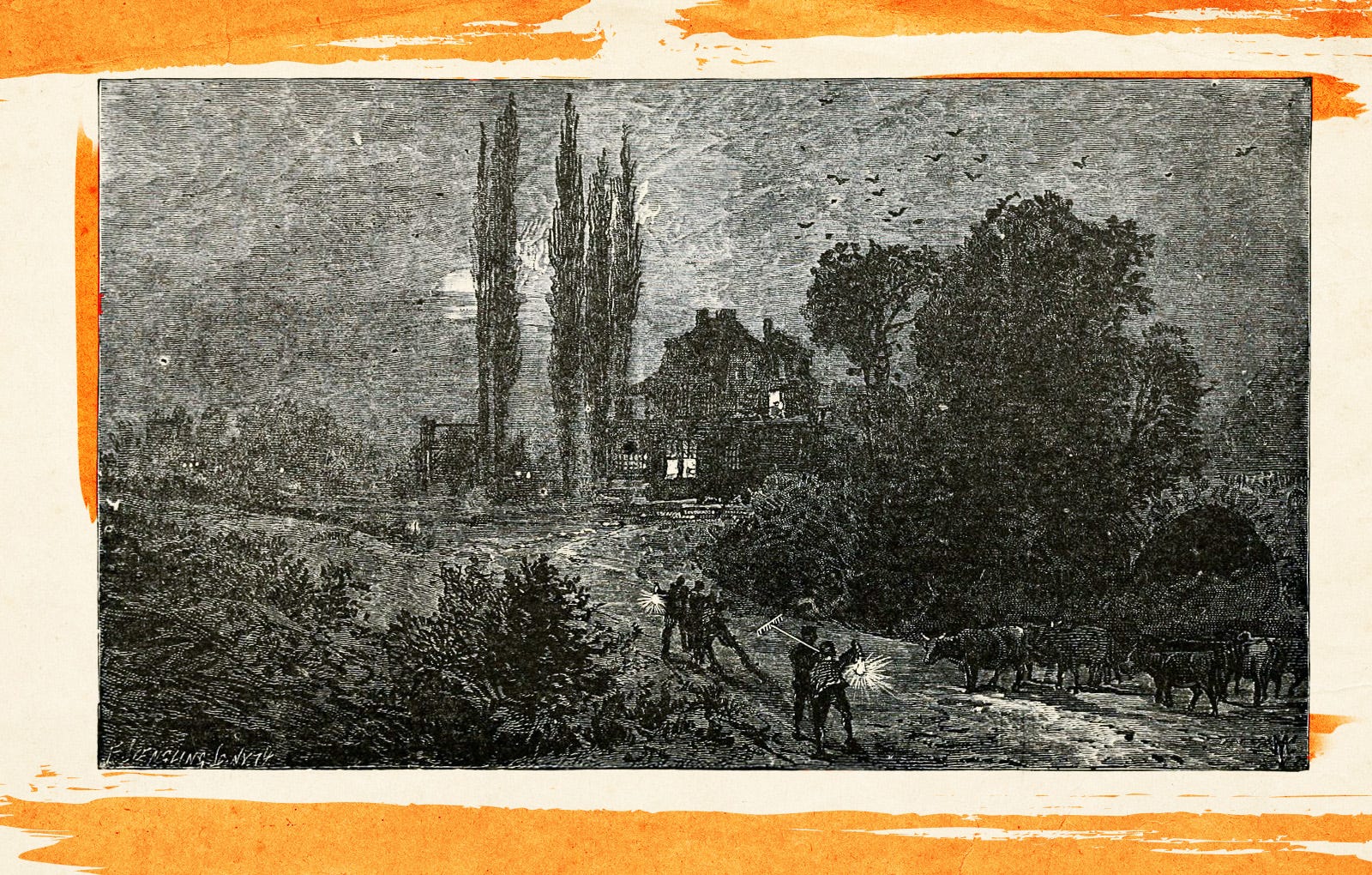
Let us remark, how black and dark,
Was the ensuing night:
And for a time the moon decline,
And did not give her light.—A Few Lines Composed on the Dark Day, May 19, 1780
On May 19th, 1780, darkness overtook New England, and the sky was as dark as night by noon. This strange event pitted the rational world against the world of the supernatural and pressed the frayed edges of resolve throughout the region. Scientific thinkers looked for physical causes, while the superstitious viewed it as a sign, a dark portent of doom. For the rational, this was an odd event that needed to be studied. For the religious and the superstitious, it was seen in different shades, some going as far as suggesting it was a divine sign of the end of days.
The people had to draw their lines in the sand and choose which side they were going to stand on: logic or superstition.
“We have had a strange Phenomena in the Natural World.”
Abigail Adams, wife to the future president John Adams, and mother to another future president, John Quincy Adams, wrote a letter to James Lovell only a few days after the event. In this letter, she gives a clear account and timeline of the event. Friday morning, the sun rose in dry weather, through a smoky atmosphere. Cloud cover became prominent around 8 in the morning, followed by a short rain.
She went on to say that after it rained, new clouds came from the northwest and spread until the skies darkened as they did during a total eclipse. But this was no eclipse. This darkness hung low and long, leading livestock to return home as animals were coaxed into their evening rituals. People took out candles for lighting before noon, and the darkness only grew deeper. She goes on to say that the evening was just as strange. It was so dark that people could not see objects nearest to them, she said, even though the moon was full.
She closed the letter with:
I have given you only my own observations. I hope some of our Philosophical Geniousess will endeavour to investigate so unusual an appearence. It is matter of great consternation to many. It was the most solemn appearence my Eyes ever beheld but the Philosophical Eye can look through and trust the Ruler of the Sky.
Though she does lean on God near the end of her letter, the rest of her descriptions remain rooted in the natural world. But this was not the case for everyone. Such an event brought out the deepest of fears and superstitions in early America.
“Must be allowed to be the effect of Divine Power.”
A published pamphlet titled “Some remarks on the great and unusual darkness, that appeared on Friday, May 19, 1780,” not only stoked superstition, it outright denied more rational explanations:
The strange hypothesis of the learned that was put in the Public Papers I cannot agree to, viz. That the great and unusual darkness was occasioned by the smoke of burnt leaves, together with the common exhalations from the earth and water. But if this be true, Why has not that smoke produced such an effect before?
The unnamed farmer who wrote the pamphlet reasoned that if smoke from a fire could do such a thing as block out the sun, he would have witnessed it before. Instead, he suggested that the physical world, the natural world, would not hold the explanation. What would, according to him? Scripture.
This may convince us, how liable the best of men are to mistakes: How dangerous is it then for us to build our faith on any man’s opinion? No wonder the apostles counselled their hearers, to search the scriptures, to see if them things were so.
So the push between the supernatural and science was set in place among the populace of New England. Between private letters, published broadsides, and newspapers publishing accounts and opinions both grounded and fantastical, the only consensus about the event was that there was no consensus.
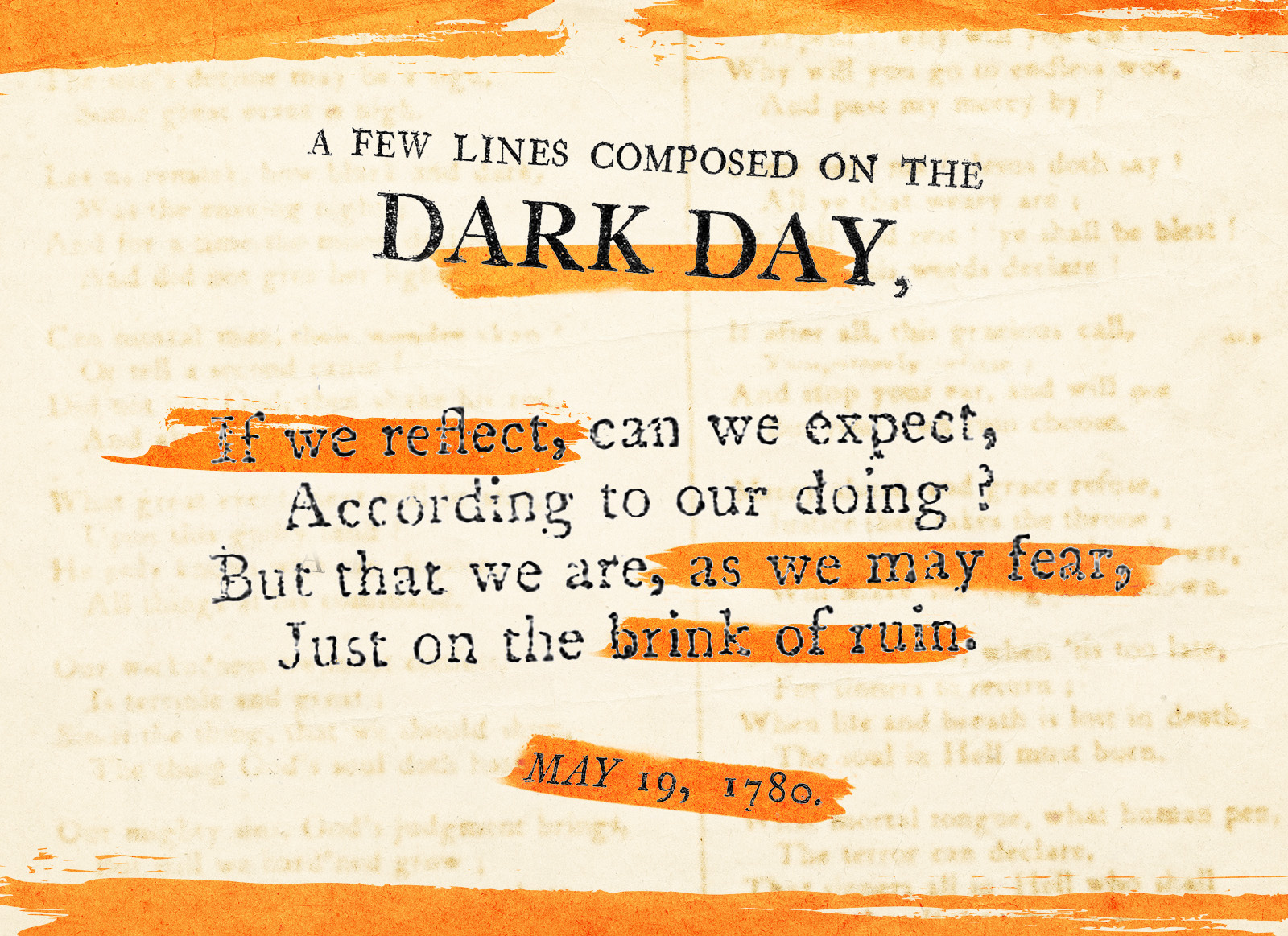
The unnamed farmer was not alone in his call for citizens of New England to find religion after the Dark Day. A poem printed as a broadside, titled “A Few Lines Composed on the Dark Day, May 19, 1780,” made the case quite passionately:
What great event, next will be sent,
Upon this guilty land?
He only knows who can dispose,
All things at his command.[...]
How sin abounds, in all our towns,
Now in these Gospel days;
How vice prevails and virtue rails,
And Godliness decays.If we reflect, can we expect,
According to our doing?
But that we are, as we may fear,
Just on the brink of ruin.Awake, awake, your sins forsake,
And that immediately;
If we don’t turn, his wrath will burn,
To all eternity.
The superstitious citizens of New England chose otherworldly and supernatural explanations, and they did so despite other available information. As seen in the pamphlet published by the unnamed farmer, many people pushed back against reasonable explanations and instead looked for signs and confirmation that the end of times was near. They wanted to believe.
“A probable Solution of the Matter.”
We have another source that wrote about the Dark Day as it happened. Cotton Tufts, a physician from Massachusetts and cousin to Abigail Adams, wrote his own letter, this one a correspondence with future president John Adams. In his letter, he mentions rain and thunder early in the morning, followed by darkness around 9 AM. Reportedly, he could not write without a candle burning.
The wind cleared cloud cover and the sun shone again around 3 PM, but the deep darkness came again as twilight approached, leading to the same deepened night that Abigail Adams reported. Unlike the Abigail Adams letter, Cotton Tufts didn’t just share his own take on the event. He also shared what others were saying:
This uncommon darkness, greater in degree and longer in duration than had ever been before amongst us occasioned much speculation, some attributed it to the influence of the planets, some to the effects of a comet and some to an eruption of a volcano. The Vulgar considered it some as portending great calamities, others as a Prelude to the general Dissolution of all Things.
While Cotton Tufts remained rational in his thoughts and recollection of the event, he admitted that the whole thing invited Biblical language, something he even did at times when describing the darkness. However, he was clear in his reasoned thoughts. This was no supernatural event. They’d seen a haze in the air for days prior. Low clouds that dropped rain in the early morning acted as a cage for a fog or smoke that was blown in on slow winds. During what should have been daylight hours, there was an odor in the air, which he described as a chimney on fire, or perhaps swamps on fire.
He lays out his theory in his letter to John Adams:
From this account must we not infer, that this extraordinary darkness was owing to a vast collection of smoke and vapours brought together by a number of concurring causes and by reason of different currents of air, conveyed in different columns or bodies so that when the rays of light struck one, they passed from that to the next with an impaired force and so on, hence the feebleness of rays which reached us.
Tufts is very clear. He does not believe that the event, however strange it may have been, was a sign or in any way related to the movement of celestial bodies or the whims of a God or gods. While some of his musing is wrapped in religious language, his opinion falls clearly on the physical explanations.
Mythology Forged in Fire
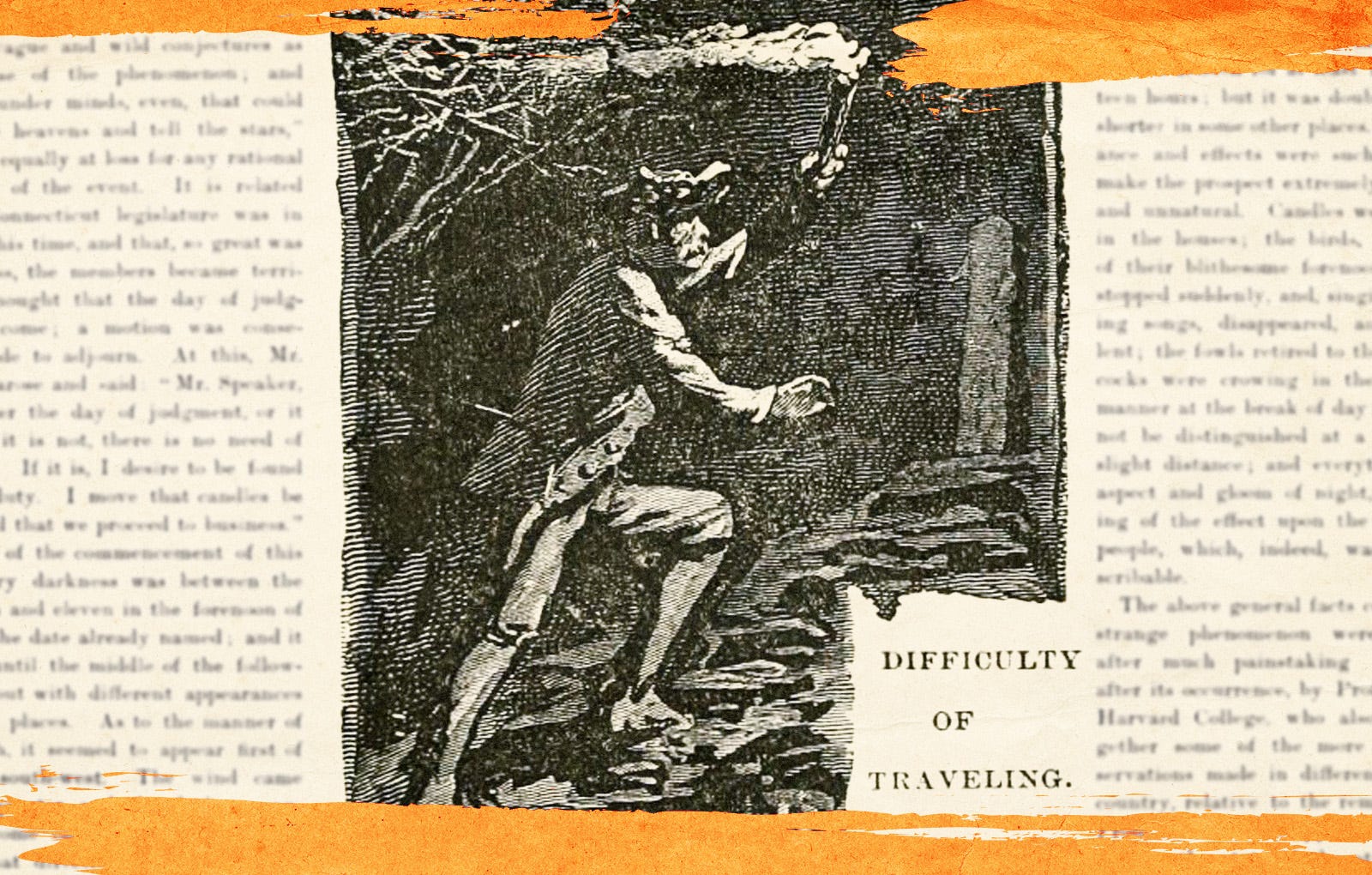
But even today, America refuses to let a good crisis go to waste, as they say. The event was used to convert sinners to believers, and even as a way to strengthen patriotic resolve. One famous story about that day discusses a legislative meeting happening in Hartford, Connecticut. As darkness wrapped the Old State House, it was suggested that they adjourn, due to fears that the strange darkness outside was the announcement of the Day of Judgment. But legislator Abraham Davenport resisted, supposedly saying, “Bring the candles,” and, “The day of Judgment is either approaching, or it is not.”
Whether or not Davenport actually said either of these things, the story was widely shared and continues to be recounted as civic-minded determination in the face of uncertainty. A piece of modern mythology or moral story for a young country was born.
Modern science supports Cotton Tufts and his rationality. According to a paper published in the International Journal of Wildland Fire in 2007, fire scars on trees in Canada provide evidence of burning fires in 1780. That, plus written accounts that tracked the weather and described sights, sounds, smells, and more, all work together to quite definitely say that a wildfire burning in Canada is the cause of the Dark Day of 1780.
Would it be enough for those who relied so heavily on religion and superstition in 1780? Probably not. As already shown through the calm and rational letters of Abigail Adams and Cotton Tufts, reasonable explanations were already available, and a mountain of evidence, such as the smells of smoke and fire, and the appearance of a hazy smoke for days prior, was there for all to observe. In a country defined by mythmaking and storytelling, and so much of it forged in fire, no amount of truth could overcome the legend.
Nineteenth of May, a gloomy day,
When darkness veil’d the sky;
The sun’s decline may be a sign,
Some great event is nigh.—A Few Lines Composed on the Dark Day, May 19, 1780
If you liked this article, please consider supporting 50 States of Strange with a small donation of any size. All articles are free, and your donation will help keep it that way.